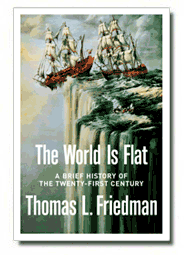
I read Friedman's The World is Flat over the holiday break. Its a good synthesis of the "IT revolution," well-written in easy to understand layman's language, but I think well-researched and intellectually firm.
Of course there were some things that bothered me. For instance, I was not sure why Friedman focuses so much on America's role in global economics (maintaining it, that is) when the thesis of the book is that borders are quickly becoming obsolete. Why should I care about the national economy over the economy of Japan, China, or even the world as a whole, when these are all intertwined anyway? As a good and rational global citizen, should I not care just as much about the economic progress in India as in Michigan?
Also, Friedman writes enthusiastically about the promise of science and engineering to propel economic development. Well, history obviously bears this out. But, wait, is there not a role for the humanities or social sciences in economic development? Friedman makes it sound like if you want to keep your edge in a competitive global economy you'd be foolish to channel your resources into anything other than science and engineering. This all seems reductionist to me; certainly it may be the case that the wealthiest society will be one of MBAs and science PhDs actively collaborating in innovation. But would this be the happiest society? It seems that Friedman got sucked into that proverbial conflation of riches with happiness, although to his credit he does recognize the need for some "friction" in the well-oiled machines of efficient economic productivity - essentially culture, emotions, traditions, art, passions, but leaves untouched the very interesting question of how this friction is necessary to that well-oiled machine.
A whole lot of people don't like science and engineering anyway, so what do you do with all those kids who want to be music and literature majors? I am not so certain that we should be pushing all our children into tech career pathways just so we can keep China from usurping our position at the top. I feel stupid just writing that, but it is grossly disturbing implication of Friedman's analysis of the "numbers and ambition gap." Moreover, and perhaps more importantly, not everyone wants to work 80-hour weeks, at least in this country. I don't because I am satisfied with working half that. I could go from an average doctor to a very wealthy doctor, but I would have no time for my family or hobbies. That's a crazy trade-off, but one that Friedman suggests we should consider since in many places throughout Asia there are lots of people who will make that trade-off, and they will crush us economically if we quit paying attention and get lazy.
Is it just me, or does this sound plain paranoid? I think this shows that Friedman, despite his smarts and experience, is really trapped in a cold war mindset based on the idea that America must constantly protect it precious way of life from any threat to its superpower status. Do the Swedes feel this way about their economic future? I wonder.
No doubt it was colonial science and industry that allowed us to conquer North America. If that had not had happened, people in Kansas would still be riding horses and hunting buffalo rather than driving Fords and eating at McDonald's. Not everyone agrees unconditionally that is improvement. We should step back and ask ourselves what Friedman does not: what do we want in life?

No comments:
Post a Comment