Big news in Portland the last week has been over our newly elected gay major. He lied about a sexual relationship he had with an 18-year old political apprentice a while back. The issue has really divided the city. You can see the very worst in the city's citizens from blogs and news comments. It is both amusing and deeply saddening.
The general line of reason people have is this:
"Sam Adams lied. This is bad judgment and he is unethical. Therefore he is unfit to be major."
There are two underlying assumptions in this line of thought. The first is that poor judgment necessarily reflects poor moral character (it does not). The second is that poor judgment reflects poor ability to act as a public official (possibly, but his is dependent on the nature of the judgment).
Is all lying equally relevant or important?
Nobody would care if Adams had lied about what kind of coffee he drinks in the morning. Everyone would care if he had lied about raping someone. So where does this scandal fit into that spectrum? It was not illegal (as far as we know), but certainly a matter of poor judgment by conventional wisdom. If you think the Major should resign ask yourself if you are upset because he lied or because of what he lied about. If the answer is the latter, then read below.
Is private sexual conduct relevant to effectively and ethically performing the duties of a public official?
I think this really depends on your general attitude towards sex, which is generally much more important to religious people. However, I am not sure there is a strong, meaningful relationship between sexual conduct in private and ability to govern in public. In fact, I doubt it because I know history has been littered with great leaders who by our prudish modern American standard led questionable lives in the bedroom. And if you think it does, she we not also apply the same standards to anyone in a position of responsibility (CEOs, professionals, educators, and so forth?) Why just stop with elected officials? But then, where do you stop - and this gets a little close to a sexual gulag.

12 January 2009
More on Why Seeing a Doctor is so Damn $$$
Washington Post columnist Robert Samuelson writes to the point today about the key issue behind uncontrollable and unsustainable health care costs. I used to think this problem was too complex and multi-factorial to really boil down to a single evil cause. But my attitude about that is changing. It is multifactorial and complex, but I think the primary driving force for health care costs in the US is, simply put, over consumption of health care resources. It's not rocket science.
We have gone far beyond a reasonable saturation point of return on investment on health care dollars. Best evidence tells us that if you have a healthy colon and no risk factors for colon cancer that after the age of 50 you are fine with 1 colonoscopy every 10 years. But our system behaves by ignoring medical evidence and fiscal sense and gives colonoscopies whenever there is the slightess excuse for one. Hey, it can't hurt to be extra careful, right? Peace of mind for the patient and piece of paycheck for the doctor. Over using CT scans or getting hi-tech arthoscopic knee surgery for 80-year old granpa is a of win-win situation for patients and doctors, and that is precisely why, as Samuelson points out, there is little incentive to change the system. Samuelson writes:
We have gone far beyond a reasonable saturation point of return on investment on health care dollars. Best evidence tells us that if you have a healthy colon and no risk factors for colon cancer that after the age of 50 you are fine with 1 colonoscopy every 10 years. But our system behaves by ignoring medical evidence and fiscal sense and gives colonoscopies whenever there is the slightess excuse for one. Hey, it can't hurt to be extra careful, right? Peace of mind for the patient and piece of paycheck for the doctor. Over using CT scans or getting hi-tech arthoscopic knee surgery for 80-year old granpa is a of win-win situation for patients and doctors, and that is precisely why, as Samuelson points out, there is little incentive to change the system. Samuelson writes:
We have a health-care system that reflects our national values. It's highly individualistic, entrepreneurial and suspicious of centralized supervision. In practice, Medicare and private insurers impose few effective controls on doctors' and patients' choices. That's the way most Americans want it. Patients understandably desire the most advanced surgeries, diagnostic tests and drugs. Doctors want the freedom to prescribe.Without thinking too long, here are 4 reasons I can think of why our system has tolerated, even begetted, this dysfunctional and destructive over-use of health care.
- There is no central oversight to spending, this is, a federal budget that will say no those unreasonable CT scans and knee replacements when they are not indicated by best medical evidence.
- Direct personal financial consequences of over-utilization by patients is minimized by comprehensive health insurance policies; patients paying high premiums are even feeling entitled to over-use so they feel they are getting their money's worth.
- There is a simulacrum of a free-market for patient choice; it is not common practice for patients to shop around for low-cost, high-quality care because costs are opaque and quality data is hard to get, and sometimes patients just don't have a choice period (taken by ambulance to the ER).
- Providers are incentivized by profits that are driven by volume (number of tests/procedures ordered, patients seen) rather than quality of care or health outcomes.
08 January 2009
The World is Flat, except when you are in the US
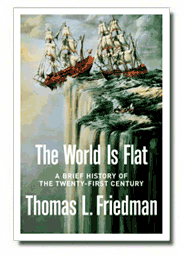
I read Friedman's The World is Flat over the holiday break. Its a good synthesis of the "IT revolution," well-written in easy to understand layman's language, but I think well-researched and intellectually firm.
Of course there were some things that bothered me. For instance, I was not sure why Friedman focuses so much on America's role in global economics (maintaining it, that is) when the thesis of the book is that borders are quickly becoming obsolete. Why should I care about the national economy over the economy of Japan, China, or even the world as a whole, when these are all intertwined anyway? As a good and rational global citizen, should I not care just as much about the economic progress in India as in Michigan?
Also, Friedman writes enthusiastically about the promise of science and engineering to propel economic development. Well, history obviously bears this out. But, wait, is there not a role for the humanities or social sciences in economic development? Friedman makes it sound like if you want to keep your edge in a competitive global economy you'd be foolish to channel your resources into anything other than science and engineering. This all seems reductionist to me; certainly it may be the case that the wealthiest society will be one of MBAs and science PhDs actively collaborating in innovation. But would this be the happiest society? It seems that Friedman got sucked into that proverbial conflation of riches with happiness, although to his credit he does recognize the need for some "friction" in the well-oiled machines of efficient economic productivity - essentially culture, emotions, traditions, art, passions, but leaves untouched the very interesting question of how this friction is necessary to that well-oiled machine.
A whole lot of people don't like science and engineering anyway, so what do you do with all those kids who want to be music and literature majors? I am not so certain that we should be pushing all our children into tech career pathways just so we can keep China from usurping our position at the top. I feel stupid just writing that, but it is grossly disturbing implication of Friedman's analysis of the "numbers and ambition gap." Moreover, and perhaps more importantly, not everyone wants to work 80-hour weeks, at least in this country. I don't because I am satisfied with working half that. I could go from an average doctor to a very wealthy doctor, but I would have no time for my family or hobbies. That's a crazy trade-off, but one that Friedman suggests we should consider since in many places throughout Asia there are lots of people who will make that trade-off, and they will crush us economically if we quit paying attention and get lazy.
Is it just me, or does this sound plain paranoid? I think this shows that Friedman, despite his smarts and experience, is really trapped in a cold war mindset based on the idea that America must constantly protect it precious way of life from any threat to its superpower status. Do the Swedes feel this way about their economic future? I wonder.
No doubt it was colonial science and industry that allowed us to conquer North America. If that had not had happened, people in Kansas would still be riding horses and hunting buffalo rather than driving Fords and eating at McDonald's. Not everyone agrees unconditionally that is improvement. We should step back and ask ourselves what Friedman does not: what do we want in life?
Subscribe to:
Posts (Atom)