Paul Krugman is pissed off at conservatives for ignoring the plain and clear evidence regarding the economic catastrophe that started a year ago. He's not the only one; Michael Specter, writer for The New Yorker, has just published a whole book on the issue of American refutation of reason and evidence.
Is this new? Probably not. Ample social science and psychiatric and neuroscience literature supports a view of the human brain as caught between emotion-driven instinct and the so-called higher cognitive powers. There was very likely an evolutionary advantage for our ancestors to act on instinct rather than reason.
But we're not in the Serengeti anymore. It is not entirely consistent with a highly literate, wealthy, democratic nation that has one of the best education systems in the world.
“It is difficult to get a man to understand something when his salary depends on his not understanding it,” Krugman quotes Upton Sinclair. Indeed, the medical corollary to this is "if you are a hammer then everything looks like a nail." To a cardiologist every patient has a heart problem. All you have to do is look.
As any pithy adage, this says a hell of a lot. Fundamentally everything boils down to incentives. Incentives and nothing more. Those may be moral incentives, but most of the time incentives are simply materialistic, especially in our Faith-embracing but spiritually devoid consumerist culture.
20 December 2009

20 October 2009
Woman loses baby because of .... H1N1 (swine) flu?
A panic inducing article on the h1n1 flu in the NY Times today. Here is but one case of likely millions of people who have contracted so-called swine flu in the US.
27 year old pregnant woman in hospital for months, ICU, ventilator, coma, and lost fetus.
She scoffs at vaccines. Shame on her (although one was not available, she wouldn't have had one). Says they contain "toxins." Shame on her ignorance.
She presented to the ER with an oxygen saturation in her blood of 70%. One would think a pregnant woman with access to the hospital would be a little more vigilant and seek care sooner.
Her father thought her ICU hallucinations indicated the presence of God in her healing. You're flipping kidding me dude. Amazing how religion blinds people from reality. A rational person would conclude the brutal course of illness was a sign from God that this woman was foolish.
A lot of red flags in this story - things that suggest a certain sociological context, rather than flu pathogenicity itself, that make me think this person was at risk for developing severe flu.
http://www.nytimes.com/2009/10/20/health/20pregnant.html?hpw
27 year old pregnant woman in hospital for months, ICU, ventilator, coma, and lost fetus.
She scoffs at vaccines. Shame on her (although one was not available, she wouldn't have had one). Says they contain "toxins." Shame on her ignorance.
She presented to the ER with an oxygen saturation in her blood of 70%. One would think a pregnant woman with access to the hospital would be a little more vigilant and seek care sooner.
Her father thought her ICU hallucinations indicated the presence of God in her healing. You're flipping kidding me dude. Amazing how religion blinds people from reality. A rational person would conclude the brutal course of illness was a sign from God that this woman was foolish.
A lot of red flags in this story - things that suggest a certain sociological context, rather than flu pathogenicity itself, that make me think this person was at risk for developing severe flu.
http://www.nytimes.com/2009/10/20/health/20pregnant.html?hpw
28 August 2009
I'm nearly 2 months into my emergency medicine residency at UConn. First month, July, was trauma, this month was anesthesia. Finally I will be in the ED next month...
A few things I've learned. The medical culture is a rougher out here on the east coast, indeed. Attendings are more likely to get in your face about something, will not sugar coat their criticisms, more likely to haze and jibe. But I don't think the culture is more toxic here than back in Oregon. Tough but not toxic.
A few take home points - a this is a gross generalization I realize. In Oregon respect and forgiveness are given to you by simply being a medical graduate and you either retain or lose them based on your performance and character. On the east coast it is the opposite. You start with zero and have to earn respect and forgiveness the day you start.
Either way here are the simple pearls:
A few things I've learned. The medical culture is a rougher out here on the east coast, indeed. Attendings are more likely to get in your face about something, will not sugar coat their criticisms, more likely to haze and jibe. But I don't think the culture is more toxic here than back in Oregon. Tough but not toxic.
A few take home points - a this is a gross generalization I realize. In Oregon respect and forgiveness are given to you by simply being a medical graduate and you either retain or lose them based on your performance and character. On the east coast it is the opposite. You start with zero and have to earn respect and forgiveness the day you start.
Either way here are the simple pearls:
- Work very hard all the time and never complain
- Show leadership and initiative in your medical decisions, and stand up for them
- Show interest and enthusiasm for everything
- Be humble
18 May 2009
Japan is Nervous about Pig Flu
 The Japanese have been holding passengers arriving from North America at Narita international airport in quarantine, checking temperatures, etc.
Japan is well known in public health circles for being exceptionally nervous about flu; it has an aging population and a national obsession with cleanliness that makes even Switzerland look messy.*Indeed, my wife, who is Japanese, spoke with her mom in Tokyo this weekend who was still freaked out about swine flu. There are nearly 130 cases of confirmed swine flu in Japan, with 0 deaths. Actually world-wide, excluding Mexico there have only been 6 deaths, or 1 in 1000 people with confirmed flu.
End of Rebel War in Sri Lanka?
I doubt it, although it will be interesting to see how an apparently crushing military defeat of a rebel militia will ensure peace. Just like when we took out Saddam Hussein. It seems to me there are ample examples in modern history that teach just the opposite. The real danger of political terrorism (rebel separatism) is not violent warfare. It's the hatred and passion buried deep in people's hearts. You can't crush that.
http://www.nytimes.com/2009/05/19/world/asia/19lanka.html?hp
http://www.nytimes.com/2009/05/19/world/asia/19lanka.html?hp
14 May 2009
Health Insurance is Not Like Others
James Kwak has a good, short piece on why health insurance doesn't make sense as a free market instrument, as other forms of insurance do:
We've all heard these stories of patients with diabetes or cancer being turned down for coverage. I think this is yet another reason why health care bucks many assumptions we have about free market economics, and why people - including way too many doctors - think that health care is best delivered in a free market system. We're not cars, to start.The analog in health insurance, however, quickly becomes unsupportable. Unfortunately, sick people (and, to a lesser extent, old people) have much higher expected health care costs than young, healthy people. In an actuarially fair health care system, their annual premiums should equal their expected annual health care costs. For someone with a serious illness, those expected costs would easily dwarf his expected income. There is no way to "buy a smaller house." So in an actuarially fair, free market system, he would be unable to get health insurance, would be unable to afford health care, and would . . . die.
Put another way, from the perspective of the insurer, the rational thing to do is charge people more than their expected health care costs, and the efficient outcome is to not insure very sick people. When we say that anyone should be able to get health insurance, we are saying that someone should be forced to lose money insuring sick people.
12 May 2009
Will child abuse expert doctors be too eager to call something abuse?
Being a child abuse expert is soon to become a medical specialty within pediatrics. It is hard to take a critical view toward this, I'm mean who wouldn't want experts to help us identify such heinous crimes against children?
However, specialization comes with a significant cost, as many generalists in medicine can attest. The adage that is often used is "when you're a hammer, everything looks like a nail." To a cardiologist, everything is a heart problem, and so on. The problem with specialization is that - like anyone - the specialist doctor can become overly invested in their knowledge niche, which is narrow and circumscribed. This can lead to bias, over-simplified conclusions, and missed insights.
My concern is of a slippery-slope nature. How much behavior toward a child will fall under the scrutiny of the child abuse expert? Good old fashioned discipline, such as spanking or washing out the mouth with soap, that many older adults experienced at the hands of their own parents? Forcing a childing to do house chores when they don't want to do? Making a child eat veggies when they refuse? These seem to be a far cry from "abuse" but there is little doubt that our politcolegal culture has also lost common sense in matters of personal responsibility - a disciplining children probably lies at the heart of that.
Here's a recent story about a daycare that was charged with putting hot sauce on tongues and squeezing arms of children that were misbehaving. You can question the style of discpline, certainly, but to call this abuse - as some in the community are - sounds like overreaction (we don't know the whole story). Ideally a child abuse expert could assist in the case with objective appraisal of evidence and clarifying what is and is not abuse. But this could backfire if everything starts to look like a nail.
However, specialization comes with a significant cost, as many generalists in medicine can attest. The adage that is often used is "when you're a hammer, everything looks like a nail." To a cardiologist, everything is a heart problem, and so on. The problem with specialization is that - like anyone - the specialist doctor can become overly invested in their knowledge niche, which is narrow and circumscribed. This can lead to bias, over-simplified conclusions, and missed insights.
My concern is of a slippery-slope nature. How much behavior toward a child will fall under the scrutiny of the child abuse expert? Good old fashioned discipline, such as spanking or washing out the mouth with soap, that many older adults experienced at the hands of their own parents? Forcing a childing to do house chores when they don't want to do? Making a child eat veggies when they refuse? These seem to be a far cry from "abuse" but there is little doubt that our politcolegal culture has also lost common sense in matters of personal responsibility - a disciplining children probably lies at the heart of that.
Here's a recent story about a daycare that was charged with putting hot sauce on tongues and squeezing arms of children that were misbehaving. You can question the style of discpline, certainly, but to call this abuse - as some in the community are - sounds like overreaction (we don't know the whole story). Ideally a child abuse expert could assist in the case with objective appraisal of evidence and clarifying what is and is not abuse. But this could backfire if everything starts to look like a nail.
14 April 2009
My First Heart Transplant
It's 4:10 am and we just put in the new heart. Certainly surgeons are morning people and start work long before most people are even out of bed. But this is not case here; no, this case started at 7:30 pm last night with a trip to retrieve the donor heart - harvesting it is called.
As we pulled on to the freeway we called the transplant coordinator to confirm we were going to the right spot. "Is that hospital name on the letter head in front of you?" the surgeon teased the coordinator. Yes, mistakes like that have been made in the past apparently, and in situations like this you will never be faulted for triple checking everything. Redundancy it the sine qua non of not screwing up. There was a second limousine too, one for the liver and kidney transplant team, and when we all left, the drivers thought they were going to different places. Yes, we got that figured out.
En route the surgeon turn to me and said he wanted me to do the sternotomy - opening up of the chest. He talked me through it, using the Bovie (an electrocauterie device used as a scalpel), and the sternal saw. "I can get the chest open in about two minutes, and have actually got someone on bypass in six." "Anyone can do this," he explained, as if to say it's not like it's heart surgery or anything, "I'm just good because I do this a lot. Ask me to diagnose a pin worm infection and I'm totally lost."
Arriving at the hospital we lugged our equipment in and quickly changed out of our scrubs into those of the hospital we were at and marched back to the OR where the patient and operating team were. There was a flurry of activity getting the patient transferred from the bed to the operating table; he was very large and difficult to move, even with 5 people. I did not know anything about the man but noticed a ventriculostomy drain in his head. He apparently had a lethal brain process - I later learned that he fell down the stairs on his way home from the bar, drunk, and caused a deadly brain hemorrhage. Sheesh. What a way to go.
Out in the hallway the transplant surgeon and the general surgeon at the hospital completed the formal paperwork to confirm the patient's identity, blood type, certification of brain death, and so on. We took a look at his echocardiogram. He heart was abnormally enlarged - probably a result of chronic hypertension - but usable.
Although the patient was brain dead, he was intubated (on the breathing machine) and sedated with general anesthesia. The body responds quite a bit to pain even when the patient is completely asleep; that said, this patient was on general anesthesia to control blood pressure and heart rate while the incisions and dissection proceeded. I took the Bovie in my hand, a simple little plastic thing resembling a pen with a thin piece of metal for a tip. I pressed the button on the handle that heated the tip and gently ran the tip across the patient's sternum to expose the breast bone. Once that was exposed the surgeon handed me a special saw for cutting the sternum, and within a minute we were looking at a beating heart.
The abdominal team was working at the same time, but their job was considerably more involved and time consuming because of the number of structures in the abdomen that they were trying to preserve - the liver, pancreas, and both kidneys. We waited until they had finished ligating all but the main arteries and veins to these organs and had freed the organs from their surrounding tissues. The organs need to be removed synchronously because once the blood flow between the liver and heart is cut, it is only a matter of minutes before the patient would completely exsanguinate.
With everyone ready, we packed the organs in shaved, sterile ice and then ligated the inferior vena cava, the main vein leading to the heart. This was the point of no return: blood poured out at 4 liters per minute, and within a few seconds I could see all the tissues and organs turn a cadaverous gray, having lost the vibrant color of life given to them by flowing blood. Then with the heart empty and struggling to beat, we filled its chambers with a chilled preservative solution that completely arrested its movement. This is key to preserving the heart outside the body - keeping it from beating that is. Yes, the heart will beat on its own independently of the body, and to some extent, independently of blood. Until it runs out of oxygen. So by arresting the heart, we can keep it from using that precious little oxygen that remains after we take it from the body. Six hours is the maximum window, but the less time the better, so time is off the essence.
It was midnight by the time we crawled back into the ambulance for the ride home. We slept most of the way, with the heart in the ice cooler on the gourney, carefully sealed in a bucket with preservative and ice.
Back at the main hospital another surgery team had been furiously working to prepare the transplant patient. He had been on a heart assist device for several months because of terminal heart failure. Although life-preserving for someone waiting on the transplant list, the machine is grusome and medieval: the patient is connected to it by several large vacuum cleaner type hoses that run air into and out of little penumatic pumps inserted into the patient's heart. It sounds like a washing machine is inside the person's chest when you listen up close.
By 2 am second surgery team was ready for the transplant. The patient was placed on total cardiopulmonary bypass, and his old heart, now barely able to do anything, was removed. The surgeon with whom I harvested the new heart gently lifted it in his hands and held it carefully to his bosom as he walked across the room to the operating table. Once the new heart was in and all the vessels connected, the heart began to quiver. It was sensing the life contained in the fresh blood, and the preservative that was keeping it from beating was now gone. The surgeons shocked the heart to kick start a normal rhythm and eventually it began to beat, just like it had been 4 hours ago in its original body.
Of course this patient and his new heart are not out of the woods. The body's immune system will see the heart as a foreign object and attempt to kill it just like it would a virus or bacteria. This happens despite donor and recipient being the same sex and blood type. The patient will be on life-long medication to suppress his immune system, basically a type of chemotherapy. We could test more deeply the characteristics of immune systems to better identify compatible organs and recipient bodies (as is the case for bone marrow transplant), but this would simply limit the already short, precious supply of organs.
Today the patient is doing as well as expected. He's recovering in the ICU off the breathing machine with a new vigorous heart, and hopefully, a new chance at life.
The abdominal team was working at the same time, but their job was considerably more involved and time consuming because of the number of structures in the abdomen that they were trying to preserve - the liver, pancreas, and both kidneys. We waited until they had finished ligating all but the main arteries and veins to these organs and had freed the organs from their surrounding tissues. The organs need to be removed synchronously because once the blood flow between the liver and heart is cut, it is only a matter of minutes before the patient would completely exsanguinate.
With everyone ready, we packed the organs in shaved, sterile ice and then ligated the inferior vena cava, the main vein leading to the heart. This was the point of no return: blood poured out at 4 liters per minute, and within a few seconds I could see all the tissues and organs turn a cadaverous gray, having lost the vibrant color of life given to them by flowing blood. Then with the heart empty and struggling to beat, we filled its chambers with a chilled preservative solution that completely arrested its movement. This is key to preserving the heart outside the body - keeping it from beating that is. Yes, the heart will beat on its own independently of the body, and to some extent, independently of blood. Until it runs out of oxygen. So by arresting the heart, we can keep it from using that precious little oxygen that remains after we take it from the body. Six hours is the maximum window, but the less time the better, so time is off the essence.
It was midnight by the time we crawled back into the ambulance for the ride home. We slept most of the way, with the heart in the ice cooler on the gourney, carefully sealed in a bucket with preservative and ice.
Back at the main hospital another surgery team had been furiously working to prepare the transplant patient. He had been on a heart assist device for several months because of terminal heart failure. Although life-preserving for someone waiting on the transplant list, the machine is grusome and medieval: the patient is connected to it by several large vacuum cleaner type hoses that run air into and out of little penumatic pumps inserted into the patient's heart. It sounds like a washing machine is inside the person's chest when you listen up close.
By 2 am second surgery team was ready for the transplant. The patient was placed on total cardiopulmonary bypass, and his old heart, now barely able to do anything, was removed. The surgeon with whom I harvested the new heart gently lifted it in his hands and held it carefully to his bosom as he walked across the room to the operating table. Once the new heart was in and all the vessels connected, the heart began to quiver. It was sensing the life contained in the fresh blood, and the preservative that was keeping it from beating was now gone. The surgeons shocked the heart to kick start a normal rhythm and eventually it began to beat, just like it had been 4 hours ago in its original body.
Of course this patient and his new heart are not out of the woods. The body's immune system will see the heart as a foreign object and attempt to kill it just like it would a virus or bacteria. This happens despite donor and recipient being the same sex and blood type. The patient will be on life-long medication to suppress his immune system, basically a type of chemotherapy. We could test more deeply the characteristics of immune systems to better identify compatible organs and recipient bodies (as is the case for bone marrow transplant), but this would simply limit the already short, precious supply of organs.
Today the patient is doing as well as expected. He's recovering in the ICU off the breathing machine with a new vigorous heart, and hopefully, a new chance at life.
16 March 2009
Health Care Spending in Mass -> higher than the rest of us.
Strangely, per capita spending on health care has increased faster than the national average in Massachusetts even since the initiation of Commonwealth Care. I think early on there was this fantasy that providing care to the uninsured would help control costs. Wrong.
The problem is not complicated. Our health care costs so much because of (1) economic incentives for all parties involved (providers, insurers, hospitals, manufacturers, drug companies); (2) consumer and physician over-reliance on expensive, unproven technology; (3) refusal to ration health care resources.
#2 is a current hot topic in the Obama effort to restructure the health care system by investing in ways to study cost-benefit of new technologies with clinical evidence. The idea is that the government will pay for a new medical widget or procedure only if the best evidence shows that it improves health outcomes that seem to be a reasonable investment for the cost of the widget.
#1 is why socialized medicine will a tough struggle in the reform effort.
#3 is the elephant in the room nobody wants to talk about, but will inevitably enter the discussion of reform with #2.
The problem is not complicated. Our health care costs so much because of (1) economic incentives for all parties involved (providers, insurers, hospitals, manufacturers, drug companies); (2) consumer and physician over-reliance on expensive, unproven technology; (3) refusal to ration health care resources.
#2 is a current hot topic in the Obama effort to restructure the health care system by investing in ways to study cost-benefit of new technologies with clinical evidence. The idea is that the government will pay for a new medical widget or procedure only if the best evidence shows that it improves health outcomes that seem to be a reasonable investment for the cost of the widget.
#1 is why socialized medicine will a tough struggle in the reform effort.
#3 is the elephant in the room nobody wants to talk about, but will inevitably enter the discussion of reform with #2.
26 February 2009
Diet Study in NEJM
In the New England Journal of Medicine this week there's a study out of Harvard that compares different diets based on macronutrient (protein, fat, carbs).
Why was the study was done?
There have been many studies on the effectiveness of different diets, but researchers don't know well weight-loss advantages of these diets when compared head-to-head.
How was the study was done?
Researches took about 800 overweight adults and assigned them to 1 of 4 diets for 2 years.
What did the study show?
Bottom line
Weight loss is not related to diet type but to calorie intake.
My comment
Why was the study was done?
There have been many studies on the effectiveness of different diets, but researchers don't know well weight-loss advantages of these diets when compared head-to-head.
How was the study was done?
Researches took about 800 overweight adults and assigned them to 1 of 4 diets for 2 years.
- low fat, average protein
- low fat, high protein
- high fat, average protein
- high fat, high protein
- All the diets were reduced-calorie diets based on the person's weight, with carbs filling out the remaining calories (so a 250 lb. person would have the same daily calories regardless of diet type).
- Dieters where given a menu of recommended foods and kept a dairy for actual food consumed.
- All the diets were consistent with heart-healthy daily amounts of saturated fats and cholesterol.
- Weight loss and waist circumference were measured.
What did the study show?
- After 6 months, average weight loss was 6 kg (13 lbs), or 7% of body weight, regardless of diet type.
- Weight was regained for most people after 12 months.
- Satiety, hunger, and satisfaction were similar for all diets.
- All diets lowered cholesterol.
Bottom line
Weight loss is not related to diet type but to calorie intake.
My comment
- Don't stress about diet fads, just focus on reducing your total calories and be consistent.
- Although you may loose weight with just calorie counting, there are other health benefits besides weight with diets high in fruits in veggies
13 February 2009
Good thing we got the DNA on those birds.
A scientist investigating the question of what species of birds the US Airways plane hit before crashing into the Hudson said the team was pretty confident of the species based on gross visual inspection of the feathers, etc., and other historical information. And, thankfully, this was all confirmed with a fancy DNA test just to be sure. Because we need that.
A DNA test? Is this THAT important?
Apply this same scenario to the millions of diagnoses and medical decisions made every day in medicine involving wiz-bang gadgets, and you get some sense of one thing that drives medical costs - our addiction to technology and compulsion to use it, regardless of necessity or cost or outcome.
A DNA test? Is this THAT important?
Apply this same scenario to the millions of diagnoses and medical decisions made every day in medicine involving wiz-bang gadgets, and you get some sense of one thing that drives medical costs - our addiction to technology and compulsion to use it, regardless of necessity or cost or outcome.
26 January 2009
Is Portland Major Sam Adams a Crook, Slimeball, or Dumbshit?
Big news in Portland the last week has been over our newly elected gay major. He lied about a sexual relationship he had with an 18-year old political apprentice a while back. The issue has really divided the city. You can see the very worst in the city's citizens from blogs and news comments. It is both amusing and deeply saddening.
The general line of reason people have is this:
"Sam Adams lied. This is bad judgment and he is unethical. Therefore he is unfit to be major."
There are two underlying assumptions in this line of thought. The first is that poor judgment necessarily reflects poor moral character (it does not). The second is that poor judgment reflects poor ability to act as a public official (possibly, but his is dependent on the nature of the judgment).
Is all lying equally relevant or important?
Nobody would care if Adams had lied about what kind of coffee he drinks in the morning. Everyone would care if he had lied about raping someone. So where does this scandal fit into that spectrum? It was not illegal (as far as we know), but certainly a matter of poor judgment by conventional wisdom. If you think the Major should resign ask yourself if you are upset because he lied or because of what he lied about. If the answer is the latter, then read below.
Is private sexual conduct relevant to effectively and ethically performing the duties of a public official?
I think this really depends on your general attitude towards sex, which is generally much more important to religious people. However, I am not sure there is a strong, meaningful relationship between sexual conduct in private and ability to govern in public. In fact, I doubt it because I know history has been littered with great leaders who by our prudish modern American standard led questionable lives in the bedroom. And if you think it does, she we not also apply the same standards to anyone in a position of responsibility (CEOs, professionals, educators, and so forth?) Why just stop with elected officials? But then, where do you stop - and this gets a little close to a sexual gulag.
The general line of reason people have is this:
"Sam Adams lied. This is bad judgment and he is unethical. Therefore he is unfit to be major."
There are two underlying assumptions in this line of thought. The first is that poor judgment necessarily reflects poor moral character (it does not). The second is that poor judgment reflects poor ability to act as a public official (possibly, but his is dependent on the nature of the judgment).
Is all lying equally relevant or important?
Nobody would care if Adams had lied about what kind of coffee he drinks in the morning. Everyone would care if he had lied about raping someone. So where does this scandal fit into that spectrum? It was not illegal (as far as we know), but certainly a matter of poor judgment by conventional wisdom. If you think the Major should resign ask yourself if you are upset because he lied or because of what he lied about. If the answer is the latter, then read below.
Is private sexual conduct relevant to effectively and ethically performing the duties of a public official?
I think this really depends on your general attitude towards sex, which is generally much more important to religious people. However, I am not sure there is a strong, meaningful relationship between sexual conduct in private and ability to govern in public. In fact, I doubt it because I know history has been littered with great leaders who by our prudish modern American standard led questionable lives in the bedroom. And if you think it does, she we not also apply the same standards to anyone in a position of responsibility (CEOs, professionals, educators, and so forth?) Why just stop with elected officials? But then, where do you stop - and this gets a little close to a sexual gulag.
12 January 2009
More on Why Seeing a Doctor is so Damn $$$
Washington Post columnist Robert Samuelson writes to the point today about the key issue behind uncontrollable and unsustainable health care costs. I used to think this problem was too complex and multi-factorial to really boil down to a single evil cause. But my attitude about that is changing. It is multifactorial and complex, but I think the primary driving force for health care costs in the US is, simply put, over consumption of health care resources. It's not rocket science.
We have gone far beyond a reasonable saturation point of return on investment on health care dollars. Best evidence tells us that if you have a healthy colon and no risk factors for colon cancer that after the age of 50 you are fine with 1 colonoscopy every 10 years. But our system behaves by ignoring medical evidence and fiscal sense and gives colonoscopies whenever there is the slightess excuse for one. Hey, it can't hurt to be extra careful, right? Peace of mind for the patient and piece of paycheck for the doctor. Over using CT scans or getting hi-tech arthoscopic knee surgery for 80-year old granpa is a of win-win situation for patients and doctors, and that is precisely why, as Samuelson points out, there is little incentive to change the system. Samuelson writes:
We have gone far beyond a reasonable saturation point of return on investment on health care dollars. Best evidence tells us that if you have a healthy colon and no risk factors for colon cancer that after the age of 50 you are fine with 1 colonoscopy every 10 years. But our system behaves by ignoring medical evidence and fiscal sense and gives colonoscopies whenever there is the slightess excuse for one. Hey, it can't hurt to be extra careful, right? Peace of mind for the patient and piece of paycheck for the doctor. Over using CT scans or getting hi-tech arthoscopic knee surgery for 80-year old granpa is a of win-win situation for patients and doctors, and that is precisely why, as Samuelson points out, there is little incentive to change the system. Samuelson writes:
We have a health-care system that reflects our national values. It's highly individualistic, entrepreneurial and suspicious of centralized supervision. In practice, Medicare and private insurers impose few effective controls on doctors' and patients' choices. That's the way most Americans want it. Patients understandably desire the most advanced surgeries, diagnostic tests and drugs. Doctors want the freedom to prescribe.Without thinking too long, here are 4 reasons I can think of why our system has tolerated, even begetted, this dysfunctional and destructive over-use of health care.
- There is no central oversight to spending, this is, a federal budget that will say no those unreasonable CT scans and knee replacements when they are not indicated by best medical evidence.
- Direct personal financial consequences of over-utilization by patients is minimized by comprehensive health insurance policies; patients paying high premiums are even feeling entitled to over-use so they feel they are getting their money's worth.
- There is a simulacrum of a free-market for patient choice; it is not common practice for patients to shop around for low-cost, high-quality care because costs are opaque and quality data is hard to get, and sometimes patients just don't have a choice period (taken by ambulance to the ER).
- Providers are incentivized by profits that are driven by volume (number of tests/procedures ordered, patients seen) rather than quality of care or health outcomes.
08 January 2009
The World is Flat, except when you are in the US
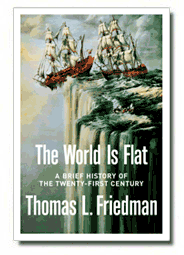
I read Friedman's The World is Flat over the holiday break. Its a good synthesis of the "IT revolution," well-written in easy to understand layman's language, but I think well-researched and intellectually firm.
Of course there were some things that bothered me. For instance, I was not sure why Friedman focuses so much on America's role in global economics (maintaining it, that is) when the thesis of the book is that borders are quickly becoming obsolete. Why should I care about the national economy over the economy of Japan, China, or even the world as a whole, when these are all intertwined anyway? As a good and rational global citizen, should I not care just as much about the economic progress in India as in Michigan?
Also, Friedman writes enthusiastically about the promise of science and engineering to propel economic development. Well, history obviously bears this out. But, wait, is there not a role for the humanities or social sciences in economic development? Friedman makes it sound like if you want to keep your edge in a competitive global economy you'd be foolish to channel your resources into anything other than science and engineering. This all seems reductionist to me; certainly it may be the case that the wealthiest society will be one of MBAs and science PhDs actively collaborating in innovation. But would this be the happiest society? It seems that Friedman got sucked into that proverbial conflation of riches with happiness, although to his credit he does recognize the need for some "friction" in the well-oiled machines of efficient economic productivity - essentially culture, emotions, traditions, art, passions, but leaves untouched the very interesting question of how this friction is necessary to that well-oiled machine.
A whole lot of people don't like science and engineering anyway, so what do you do with all those kids who want to be music and literature majors? I am not so certain that we should be pushing all our children into tech career pathways just so we can keep China from usurping our position at the top. I feel stupid just writing that, but it is grossly disturbing implication of Friedman's analysis of the "numbers and ambition gap." Moreover, and perhaps more importantly, not everyone wants to work 80-hour weeks, at least in this country. I don't because I am satisfied with working half that. I could go from an average doctor to a very wealthy doctor, but I would have no time for my family or hobbies. That's a crazy trade-off, but one that Friedman suggests we should consider since in many places throughout Asia there are lots of people who will make that trade-off, and they will crush us economically if we quit paying attention and get lazy.
Is it just me, or does this sound plain paranoid? I think this shows that Friedman, despite his smarts and experience, is really trapped in a cold war mindset based on the idea that America must constantly protect it precious way of life from any threat to its superpower status. Do the Swedes feel this way about their economic future? I wonder.
No doubt it was colonial science and industry that allowed us to conquer North America. If that had not had happened, people in Kansas would still be riding horses and hunting buffalo rather than driving Fords and eating at McDonald's. Not everyone agrees unconditionally that is improvement. We should step back and ask ourselves what Friedman does not: what do we want in life?
Subscribe to:
Posts (Atom)